GeneArt Instant Designer
Creating a streamlined, guided experience for researchers designing and purchasing synthetic genes
Company:
Thermo Fisher
Role:
Product Designer
Tools:
Sketch
Overview
GeneArt Instant Designer is a web-based tool from Thermo Fisher Scientific that enables researchers to design and order synthetic genes with ease. The tool automates codon optimization, cloning vector selection, and validation, helping users streamline their gene synthesis workflows without needing to contact support or use offline tools. As a UX/UI Designer at Thermo Fisher, I partnered with product managers, scientists, and engineering to design the tool's interface—focusing on making complex biological inputs more approachable and reducing friction in the ordering process.
Team
Jonelle Boyd, Product Designer
Bee Im Teo, Product Manager
Molecular Biology Subject Matter Experts
Goals
• Simplify the gene entry and optimization process for both novice and experienced researchers
• Increase conversion rates by reducing errors and friction in the self-service flow
• Improve confidence and clarity at each step of the synthesis journey
• Align the experience with Thermo Fisher’s broader eCommerce and product ecosystem
Challenge
The legacy version of Instant Designer was functional but overwhelming. It relied heavily on scientific jargon, offered limited feedback on errors, and lacked guidance through critical steps like sequence optimization and cloning. Users—especially those outside of molecular biology specialties—often abandoned the flow or reached out to support, which defeated the tool’s purpose as a self-service solution.
Key Challenges
Dense terminology and unclear validation feedback
Limited flexibility in choosing vectors or optimization strategies
Inconsistent visual design that diverged from Thermo Fisher’s eCommerce standards
My Approach
To address the complexity while preserving scientific accuracy, I applied a step-by-step, user-centered design approach:
User & Stakeholder Interviews
I worked with product managers and scientific experts to understand user needs and edge cases. We also reviewed customer support logs to identify common friction points.Flow Redesign & Simplification
I restructured the experience into a guided, multi-step workflow that walked users from DNA sequence input and optimization through cloning vector selection, design validation, and checkout.Design System Alignment
I applied Thermo Fisher’s Komodo design system to unify UI elements and align with the broader eCommerce experience.
User Journey
We focused on reducing cognitive load and offering contextual support at each step. Key improvements included:
Inline validation and tooltips to help users understand biological requirements
A real-time optimization preview to visualize codon changes
A visual gene map showing cloning site placement and sequence features
An updated vector selector with filtering and preview functionality
Research & Insights
We benchmarked the experience against other gene synthesis tools, like IDT and Twist Bioscience, and surveyed internal tools used by support staff.
Key Insights
Competitors lacked transparency during optimization steps
Most tools overwhelmed users with too many options up front
Internal researchers favored a more visual, interactive approach

Solution
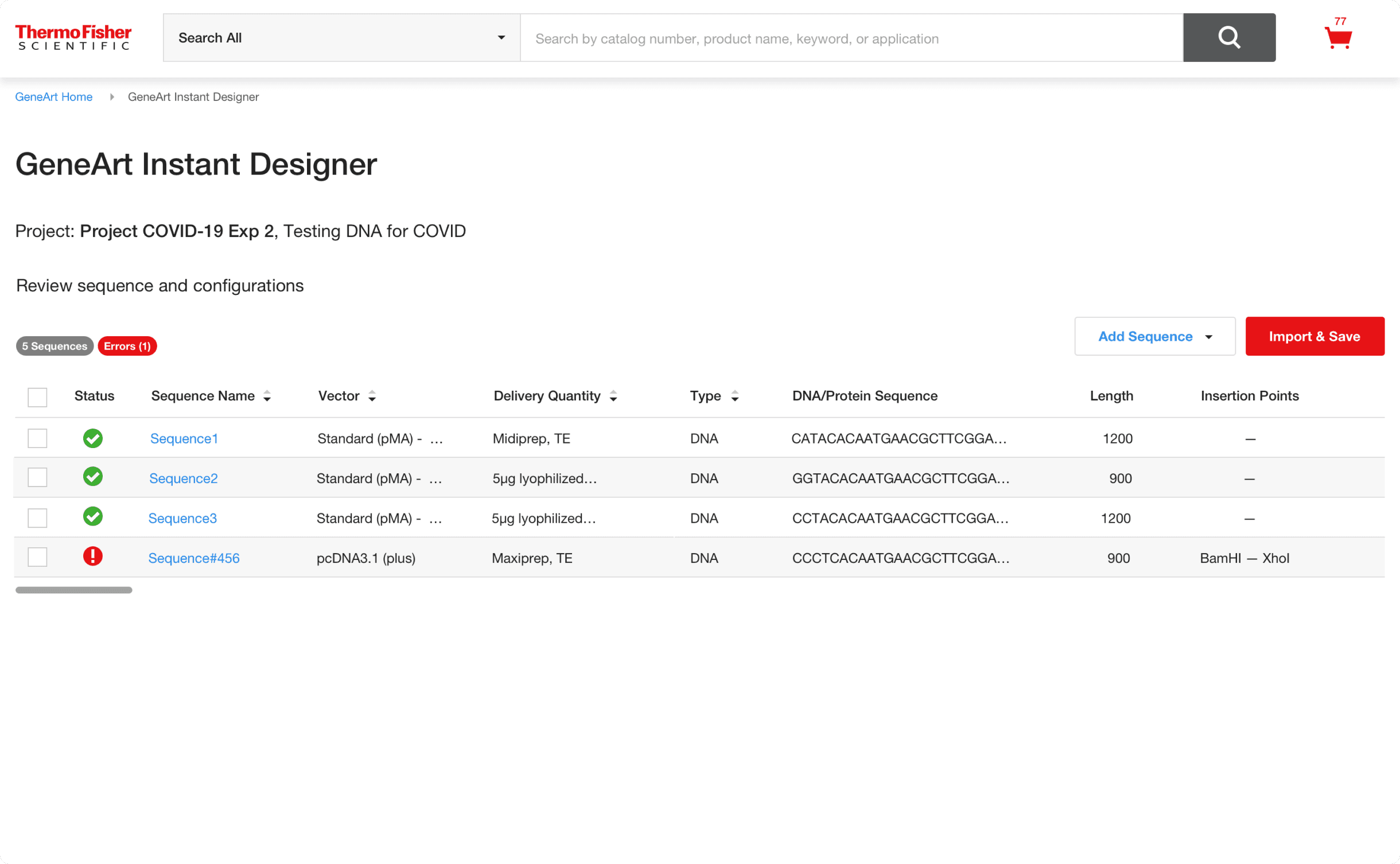
The final design introduced a clean, modular UI with clear progress indicators and contextual help. Key features included:
A multi-step wizard layout
Visual sequence viewer and map
Smart defaults for cloning and optimization
Embedded biological logic for error handling and validation



Impact/Outcome
The redesigned experience significantly improved usability and adoption among researchers. After launch:
Key Results & Metrics
40% increase in successful self-service order submissions
25% reduction in support ticket volume related to gene synthesis
Improved customer satisfaction scores in post-order surveys
While the redesign focused on the core ordering flow, future opportunities include integrating the tool more seamlessly with Thermo Fisher’s broader digital ecosystem—such as enabling batch ordering, user account customization, and real-time order tracking. These additions could further enhance user autonomy and improve the experience for research teams managing high volumes of synthetic gene requests.